
Westfield City Directory Collections by Year
Westfield's historical shelf is strongest when the year is chosen first. The DigiFind-It city-directory collection carries a headline range from 1885 through 1982, but it is not a complete annual run. It lists 51 directory items, and each scan must be checked before a date is cited. Westfield Memorial Library is the local keeper behind the digitized collection, while its Local History Room supplies an on-site route for material that is not convenient to use from a scan.
| Collection | Years | Where held | Access |
|---|---|---|---|
| DigiFind-It directory volumes | 1885-1982 headline; 51 listed items with gaps | Westfield Memorial Library / DigiFind-It | Year-specific digitized scans |
| 1944 Westfield directory | 1944 | DigiFind-It | Alphabetical and street sections in the digitized volume |
| R.L. Polk volume | 1977 | DigiFind-It | Digitized volume with four named sections |
| Newspapers, yearbooks, and local documents | Series-specific coverage | Westfield Memorial Library / DigiFind-It | Scan and collection availability varies |
| Sanborn maps | 1886, 1891, 1896, 1901, 1909, 1916, 1921, 1928 | Princeton guide and library microfilm | Guide online; restricted map years on site |
The browse list shows 1885-86, 1901-05, 1907-22, 1924-25, 1927-30, 1936-39, 1941, 1944, 1947-48, 1951, 1955, 1961-66, 1968-69, 1971-80, and 1982, with the displayed gaps preserved. An absent year can mean the collection has a gap, the town was not included, or the relevant scan is incomplete. It does not establish that a household left Westfield.
Start with the digitized Westfield city-directory browse when selecting a volume.
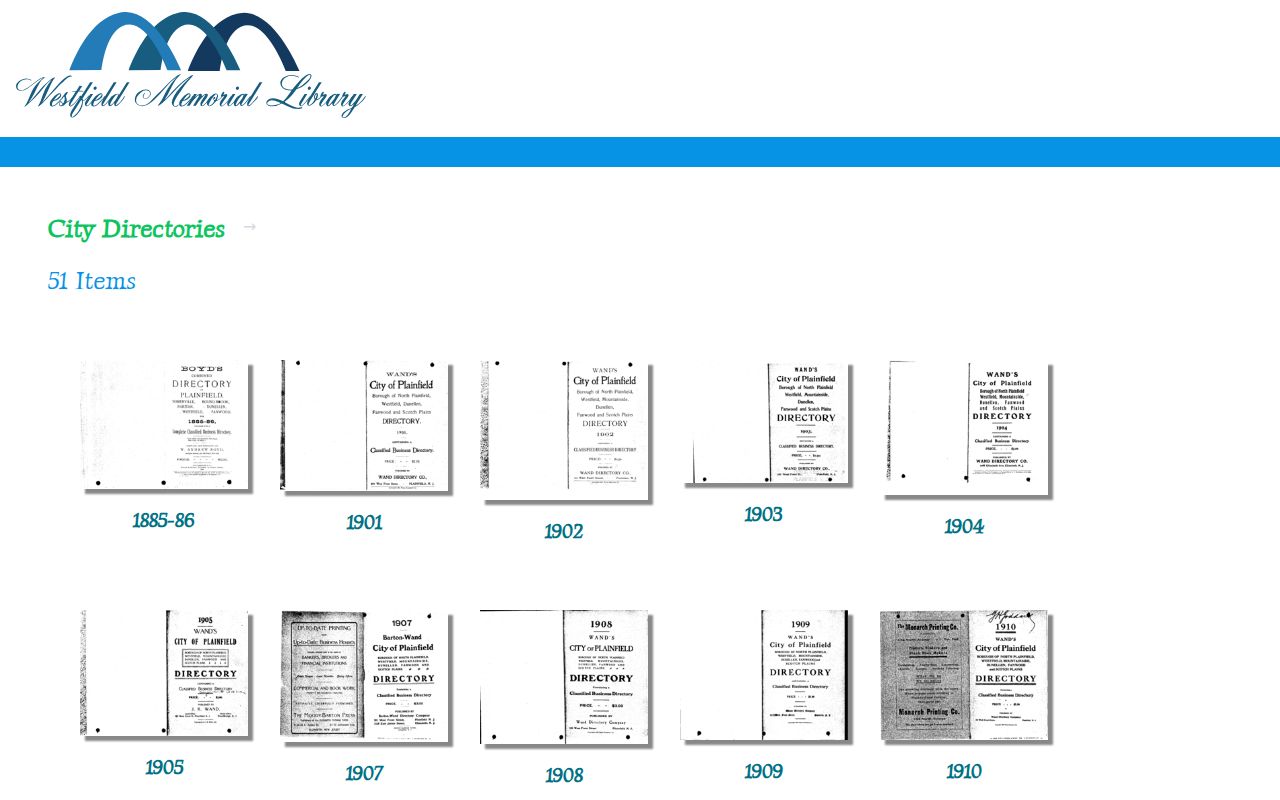
The browse screen is useful for recording the exact volume title and year before transcribing an entry or comparing consecutive directories.
Westfield's Digitized Research Shelf
The library's digital collections are arranged as more than a run of city directories. Audios, documents, newspapers, publications, yearbooks, and external links sit beside the directory scans. That arrangement helps when a city-directory line is thin. A surname and street can be tested in a newspaper notice, a yearbook, a cemetery or baptism item, a marriage record, or a local publication without assuming that any one source settles identity.
The newspaper series include the Union County Standard from 1891-1915, the Westfield Leader from 1907-2024, the Westfield Record Press from 1990-2007, and the Scotch Plains Times from 1963-1989. Yearbooks span 1922-2016. For each match, preserve the collection name, publication date, page or scan identifier, and the spelling printed at the time. That small record makes a later correction possible.
Westfield Directory Research Access
Westfield Memorial Library's Local History Room is at 550 East Broad Street and can be reached at 908-789-4090. The room is available by appointment or reservation, and its material remains on site unless staff approve another arrangement. This is the practical fallback when a digitized city directory does not contain the needed year or when a reader needs a map or microfilm reel beside the directory.
The posted library hours are Monday through Thursday from 9:30 a.m. to 8:30 p.m., Friday and Saturday from 9:30 a.m. to 4:30 p.m., and Sunday from 1 to 5, subject to change. Contact the library with a surname, street, and target year rather than a broad request. It gives staff a useful way to confirm whether a volume, newspaper run, map reel, or document is available before an on-site visit.
Note: Appointment rules and posted hours can change, so confirm access conditions before carrying a research list to the Local History Room.
A 1977 Westfield City Directory Comparison
The 1977 volume is a useful check against a false local match. Its full title names Westfield, Cranford, Garwood, Kenilworth, and Mountainside, and R.L. Polk & Co. published it. A surname in that scan therefore needs a municipality and section check before it is assigned to Westfield. The book contains a Buyers' Guide and Classified Business Directory, an Alphabetical Directory, a Street Directory of Householders and Businesses, and a Numerical Telephone Directory.
| Alphabetical section | Begins with the printed name and carries the directory's related information. |
|---|---|
| Street section | Places household and business entries in street order. |
| Numerical telephone section | Offers a separate printed route where a period telephone listing is relevant. |
| Classified section | Indexes businesses and institutions by the volume's own categories. |
This five-town setup is a valuable comparison rather than a flaw. Search the same name in each named locality, then keep only the entry whose locality and street agree with another dated source. The directory's 201 area-code reference and its $75 cover-price notation describe that published volume; they do not make the volume a current telephone or address source.
Reading a Westfield City Directory Entry
The 1944 Westfield volume explains that an alphabetical line may preserve a full name and spelling, occupation or business description as printed, a residence street, a spouse or household notation, and a designation such as head of house or roomer. It also includes organizational and public-officer material. These are historical printing fields. A result should be transcribed as the volume presents it, with a page reference, and never converted into a claim about a living person.
| Name line | The printed surname and given name, including initials or alternate spelling. |
|---|---|
| Household notation | A spouse, head-of-house, or roomer mark if the volume prints one. |
| Street address | The residence street and number when the alphabetical section supplies it. |
| Street position | The street-section sequence and cross-street context when available. |
| Source marker | Directory title, year, publisher, scan page, and any abbreviation used. |
- Criss-cross directory
- A directory arranged by street and number so names can be read in address order.
- Householder index
- A name-focused listing that identifies the person or household in the form chosen by the publisher.
- Abbreviation key
- The front-matter guide that explains shortened words and symbols in that particular volume.
Photograph or save the abbreviation key before expanding a short line. A familiar mark can mean something different from one publisher or year to the next, and an unexpanded abbreviation is better than a confident guess.
Westfield City Directory Street Clues
The 1944 street directory does more than repeat names. It identifies streets, gives cross-street context, and places occupants in sequence. When an alphabetical line has no number, or when a number is hard to read, the street section can place the building between cross streets. That rescue method is especially useful for a house that appears poorly numbered in an old scan.
Record the address exactly as printed, then compare the directory street sequence with a tax map, deed legal description, or Sanborn sheet. Westfield research did not locate a verified town renumbering or renaming schedule. A mismatch is a prompt to preserve both versions and investigate, not a reason to silently replace an old address with a modern one. For present-day parcel work, use the Westfield streets directory route after the historical location is pinned down.
Westfield Sanborn Maps Beside Old Volumes
Directory years can be paired with Westfield Sanborn sheets for 1886, 1891, 1896, 1901, 1909, 1916, 1921, and 1928. The maps show building footprints, construction materials, uses, outbuildings, street geometry, and nearby landmarks. They can confirm that a building or use existed at a time, but they do not identify every person connected to that building.
Use the Princeton Westfield Sanborn guide to identify a year and sheet before requesting the map.
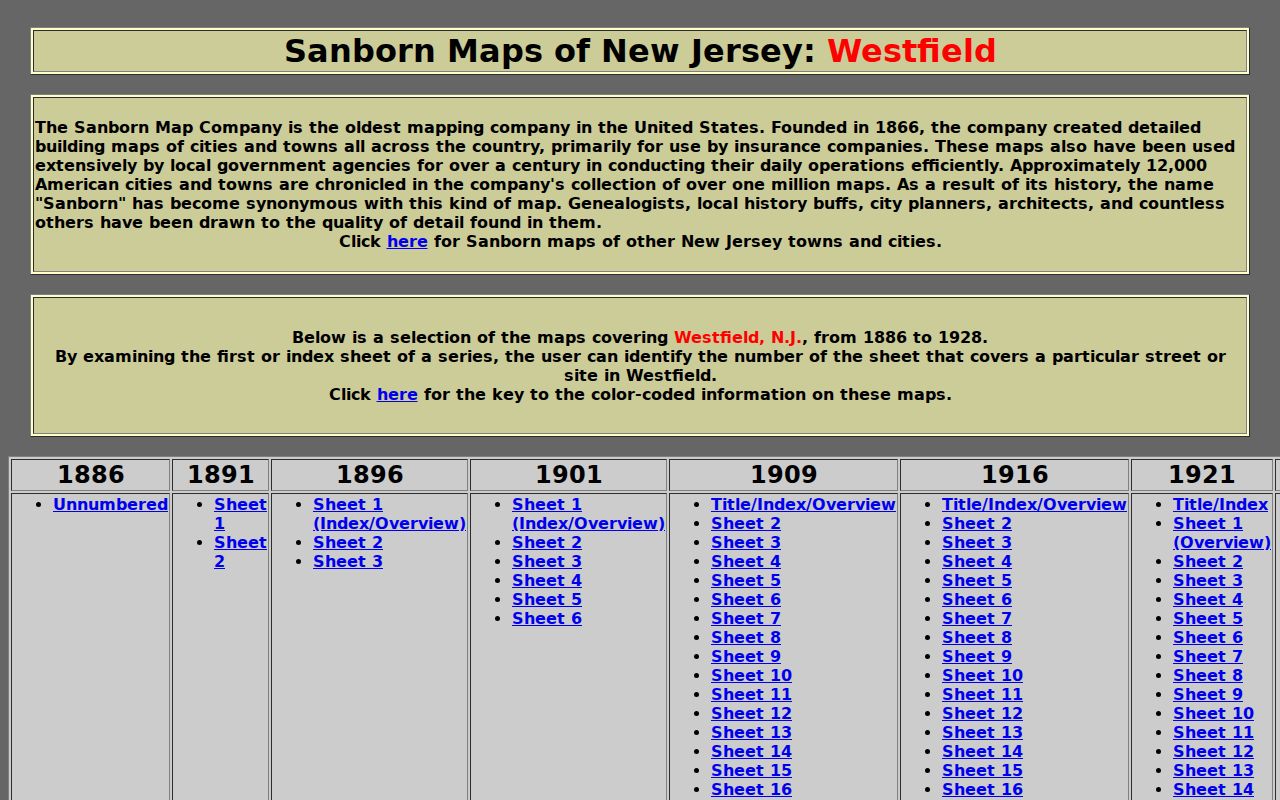
The guide's year list should be paired with the Library's microfilm when an online image is restricted by copyright. An unavailable web scan is an access condition, not proof that the historical map is missing.
Tracing Westfield City Directory Households
A household trail works best as a dated sequence. Choose the available directory closest to the event, search its alphabetical listing, and then check the street section. Match that address with a census record only after the date and geography make sense. New Jersey state census series include 1855, 1865, 1875, which is incomplete, 1895, and 1915; federal census research extends from 1840 through 1950 through the access routes identified by the State Archives.
- Select the closest available directory year and record the complete title and scan page.
- Search the alphabetical section for spelling variants, initials, and a possible household notation.
- Turn to the street or criss-cross section and preserve the number, cross streets, and nearby sequence.
- Pair the dated address with the appropriate census year, keeping township geography separate from the modern municipal label.
- Test a disappearance with an adjacent directory, newspaper, cemetery, church, deed, or archival source before drawing a conclusion.
A name missing from a Westfield city directory may reflect a collection gap, an omitted household, a different spelling, or a move. The best follow-up is a second dated record, not an assumption. Newspapers can add an event or organization detail, while cemetery, marriage, baptism, and archive materials can narrow a family connection.
Westfield Historical Society Follow-Up
The Westfield Historical Society archives hold photographs, maps, newspapers, postcards, scrapbooks, architectural drawings, organization material, and information about past residents. The archives are at 302 Elm Street, on the third floor of the Board of Education. Visits are generally Tuesday and Thursday mornings from 9:30 to noon by appointment, with security registration. The Reeve Center is at 314 Mountain Avenue and lists 908-654-1794.
Archive material can add context to a directory line, but the date and source type still matter. A photograph or scrapbook is a lead that should be checked against the directory scan, a map, or a primary record.
The Genealogical Society of New Jersey is a statewide extension for Bible and family records, cemetery transcriptions, manuscripts, and the Genealogical Magazine of New Jersey. Its collections are public but generally appointment-based under its temporary reading-room arrangement, and it accepts research inquiries.
That broader collection can help when a Westfield city-directory lead reaches beyond town boundaries or needs a family, cemetery, or manuscript comparison.